MN State Arts Board Creative Individuals Grant, 2026
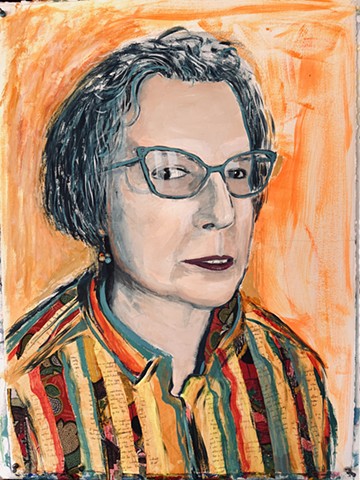
Portrait of Ilene, acrylic collage on BFK Rives, 30” 23”, 2026
Caregiving can be joyful, gracious, loving; and also exhausting, challenging and most of all isolating. Caregivers can often be unseen and unrecognized, so this year my portraits amplify stories of caregivers and the people they care for. Here is one of the portraits and stories that came to mind from my friend, Ilene, about herself and her husband, Zoran:
“A standout healing memory for Zoran is from his childhood. Every summer he stayed with his grandma, Baba Duka, in her village in southeastern Serbia. He was about 6 years old and developed a rash on his body. Baba Duka organized a healing ceremony in the village. He was told to lie down in the middle of a circle, and it was delineated with sheep’s wool. Next, the wool was lit on fire, and Baba chanted to expel the rash from Zoran’s body from the Jerma River to the next river and beyond. Zoran remembers thinking Baba was crazy, but the rash disappeared the next day.
Zoran heals best when he’s not fussed over. He didn’t grow up with that kind of nurturing, so prefers to be left alone. Although, there always has to be bread in the house! Bread is a staple and healing for him.
When Zoran is asked to support me during an illness, I have to tell him what I need. He won’t be able to intuit that. For example, he was very reliable when I needed to go to the doctor or receive radiation treatment. He would also pick up food and grocery shop for what I wanted. Although, I did have to write out a list for him.
*******
I grew up with a nurturing Mother, Sally. She was very attentive when I was sick. Probably, I was on the fragile side. One memory from childhood is when she rolled the portable tv, and/or set up the steamer in my room when I had a virus. Campbell’s chicken noodle soup and saltine crackers were comforting lunches. Plus, I could always wake her up in the middle of the night, and say, “I don’t feel well.” She’d say, “poor you,” and get a cold washcloth if I had a fever.
The contrast between the way Zoran and I were treated when sick is part familial and part cultural. Probably, gender has something to do with it as well. Guys should bear the pain, and girls should be pampered. A stereotype, yes, but part of my perceived experience.”